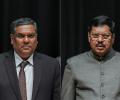
From demonetisation to sub-categorisation of Scheduled Castes to bulldozers, Justice Gavai has been part of several judgments.
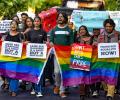
A five-judge bench of the Supreme Court will consider review pleas challenging the October 2023 verdict that declined legal sanction to same-sex marriage. The review pleas will be heard in chambers on January 9, with Justice P S Narasimha being the only member of the original bench that delivered the verdict.
The Supreme Court on Thursday dismissed a batch of pleas seeking to review its October 2023 verdict declining legal sanction to same-sex marriage.

Senior-most Supreme Court judge Sanjiv Khanna on Wednesday recused himself from considering pleas seeking review of the apex court's judgment last year declining legal recognition to same-sex marriage, sources said.
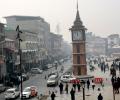
Highlights of the judgment pronounced by a five-judge Constitution bench of the Supreme Court that on Monday unanimously upheld the Centre's decision to abrogate provisions of Article 370 of the Constitution bestowing special status on the erstwhile state of Jammu and Kashmir.
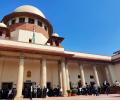
A five-judge bench headed by Chief Justice DY Chandrachud considered the pleas in chambers and dismissed applications for listing of the review petition in open Court.
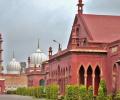
There is nothing "fundamentally inconsistent" with a minority institution being an institution of national importance (INI), the Supreme Court said on Wednesday while hearing arguments on the vexed issue of minority status to Aligarh Muslim University (AMU).

A bench of Chief Justice Ranjan Gogoi and Justices S K Kaul and K M Joseph held that it was not appropriate for the apex court to interfere in the ongoing investigation.

According to the cause list of July 10 uploaded on the apex court website, a five-judge bench headed by Chief Justice DY Chandrachud would consider in chambers the pleas seeking review of the October 17 last year verdict.

The collegium, also comprising Justices Sanjay Kishan Kaul, Sanjiv Khanna, B R Gavai and Surya Kant, recommended the names of Delhi high court Chief Justice Satish Chandra Sharma, Rajasthan high court Chief Justice Augustine George Masih and Gauhati high court Chief Justice Sandeep Mehta as top court judges.
The Collegium had proposed Justice Singh's transfer on August 3 for "better administration of justice".
Justice Muralidharan had directed the state government to consider the representation for ST status to the majority Meitei community and write to the Centre within four weeks.
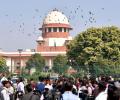
Chief Justice Chandrachud said the court will allow the lead counsel from the petitioner's side to argue on all aspects and rest of the counsel can add on certain aspects, so that there are no overlapping arguments.

The Supreme Court on Tuesday reserved its verdict on a batch of pleas challenging the abrogation of Article 370 of the Constitution which bestowed special status on the erstwhile state of Jammu and Kashmir.
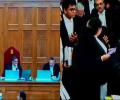
Who can recommend the revocation of Article 370 in Jammu and Kashmir when no constituent assembly exists there? The Supreme Court on Wednesday put this question to the petitioners who have challenged the abrogation of the constitutional provision that bestowed special status on the erstwhile state.

According to the cause list for December 11, Monday, uploaded on the apex court website, a five-judge constitution bench headed by Chief Justice D Y Chandrachud would deliver the verdict.

The Supreme Court on Monday ruled the former state of Jammu and Kashmir did not have any 'internal sovereignty' that was distinguishable from the powers and privileges enjoyed by other states in the country.

Solicitor General Tushar Mehta, the Centre's key counsel in defending the abrogation of Article 370 of the Constitution, said on Monday the Supreme Court verdict upholding the government's August 5, 2019, decision will go down in history as the one that corrected a "Himalayan constitutional blunder" of gigantic proportions.
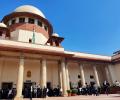
A three-judge bench headed by Justice Sanjay Kishan Kaul was hearing the pleas seeking reconsideration of the July 27, 2022 verdict by a three-judge bench on certain parameters.
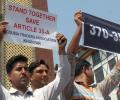
Several petitions challenging the Centre's decision to abrogate the provisions of Article 370 and the Jammu and Kashmir Reorganisation Act, 2019, which split J-K into two Union Territories Jammu and Kashmir, and Ladakh were referred to a constitution bench in 2019.

The Supreme Court on Tuesday termed as "unacceptable" the submission that Article 370 of the Constitution ceased to operate once the term of the constituent assembly of Jammu and Kashmir ended in 1957 after drafting the state's constitution.
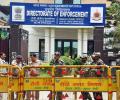
The Supreme Court said on Wednesday it will examine whether its 2022 verdict upholding the Enforcement Directorate's (ED) powers to arrest and attach property involved in money laundering under PMLA required any reconsideration.
The collegium, also comprising Justices Sanjay Kishan Kaul and Sanjiv Khanna, met on Thursday and its decision was uploaded on the apex court website.
On August 10, the collegium also comprising justices Sanjay Kishan Kaul, Sanjiv Khanna, BR Gavai and Surya Kant had proposed transfer of Justice Bhatnagar to the Rajasthan high court for better administration of justice.
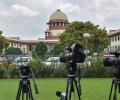
The Collegium's recommendations, if accepted by the Centre, will raise the total number of judges in the apex court to 33 against the sanctioned strength of 34 including the CJI.
One of the resolutions uploaded on the apex court website said a vacancy in the office of the chief justice of the Uttarakhand high court has arisen consequent upon retirement of Justice Vipin Sanghi on October 26, 2023.

The top court said that a sum of Rs 50 crore lying with the RBI for the victims shall be utilised by the Union of India to satisfy pending claims of victims.
Is there no mechanism to abrogate Article 370 even when the people of Jammu and Kashmir want it, the Supreme Court asked on Thursday and wondered if the now repealed provision can't be touched, will it not amount to creating a "new category" beyond the basic structure of the Constitution.

The Supreme Court on Monday asked National Conference leader Mohammed Akbar Lone to file an affidavit swearing allegiance to the Constitution of India and accepting the country's sovereignty, after the 'Pakistan zindabad' slogan that he allegedly raised in the Jammu and Kashmir assembly in 2018 kicked up a massive row.

In an emphatic victory for the Modi government, the Supreme Court on Monday unanimously upheld its decision to abrogate Article 370 of the Constitution that bestowed special status upon the erstwhile state of Jammu and Kashmir, ordered restoration of statehood "at the earliest" and set a September 30, 2024, deadline for holding the assembly elections.
The collegium said the Chief Justice of the Delhi high court, in consultation with his two senior-most colleagues, had on May 30 recommended the elevation of the judicial officers as judges of that high court.
A five-judge constitution bench of Justices SK Kaul, Sanjiv Khanna, A S Oka, Vikram Nath and J K Maheshwari had reserved its judgement on September 29, 2022.

He also said "forward-looking" policies and judgements were needed to ensure that the benefits of social welfare measures actually reach the citizens.

An institution of national importance must reflect the "national structure", the Centre told the Supreme Court on Tuesday while pointing out that around 70 to 80 per cent students studying at Aligarh Muslim University (AMU) are Muslims even without reservation.
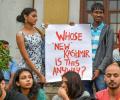
The Supreme Court said on Thursday the surrender of Jammu and Kashmir's sovereignty to India was "absolutely complete" with the accession of the former princely state in October 1947, and it was "really difficult" to say that Article 370 of the Constitution, which accorded special status to the erstwhile state, was permanent in nature.
Was the decision taken by the Centre on August 5, 2019 to abrogate the provisions of Article 370 of the Constitution, which bestowed a special status on the erstwhile state of Jammu and Kashmir, constitutionally valid? The Supreme Court is scheduled to pronounce its verdict on Monday on a batch of petitions challenging the abrogation of the provisions of Article 370.

'Given the current dispensation, I have no hope for the legislature passing a law in favour of the LGBTQ community.'

The Supreme Court collegium headed by Chief Justice D Y Chandrachud on Wednesday recommended to the Centre the names of Justice Ujjal Bhuyan, the chief justice of the Telangana high court, and Justice S Venkatanarayana Bhatti, his counterpart in Kerala, for elevation as judges of the apex court.
The Bharatiya Janata Party said that there should not be any politics on the Supreme Court ruling and everyone should respect it.

Article 142 of the Constitution deals with the enforcement of decrees and orders of the apex court.
 © 2026 Rediff.com - Advertise with us - Disclaimer - Privacy Policy - Sitemap - Feedback - About us - Terms of use - Grievances